Where should a midi dress fall on a petite woman?
"Midi" isn't a fixed length — it's wherever the hem lands on you. On a frame 5'4" and under, a regular midi often hits the one spot that shortens the leg most.

Midi dresses are usually drafted with a hem 2–4 inches below mid-calf on a 5'6" fit model. Take a few inches of height away and that same hem slides down to the fullest part of the calf — or lower, to the awkward spot just above the ankle where the dress looks neither midi nor maxi. That's why so many petite women say midis "don't suit" them. Usually it's the length, not the style.
The zone to avoid: the widest part of the calf
A horizontal line draws the eye and makes whatever it crosses look wider. A hem sitting right across the fullest point of the calf widens the leg and visually shortens it. This is the length most regular-sized midis land at on a petite frame.
Zone 1: just below the knee
The most versatile petite midi length ends 1–3 inches below the knee, above where the calf starts to widen. It shows the slimmer part of the lower leg, works with flats, sandals and heels, and reads as polished for work or events. If you're under 5'2", this is often the most flattering midi length.
Zone 2: above the ankle swell
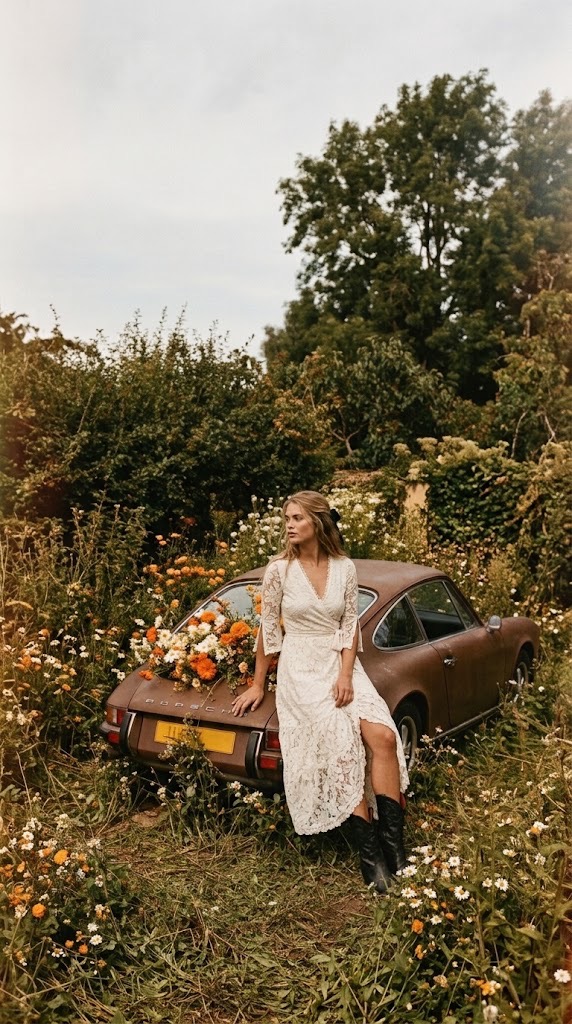
The second option is longer: the hem lands where the calf narrows toward the ankle, about 3–5 inches above the ankle bone. It feels more relaxed and pairs well with tall boots that meet the hem, as in the photo above, or with a pointed flat.
How to find your number
- Stand in the shoes you'll wear most and measure from the top of your shoulder (where a seam would sit) down to each zone.
- Note both numbers — that's your below-knee and above-ankle length.
- Compare them to the "shoulder to hem" measurement on a product page, not the size label.
Our guide to reading garment measurements explains where brands measure from.
Other details that help
- A defined waist keeps the skirt from overwhelming your torso.
- A-line or bias cuts that skim the body move better than stiff, wide skirts.
- A V-neck, slip neckline or bare arm balances the extra length below.
- Matching shoe and hem tones, or boots that meet the hem, avoid a second break.
For the bigger picture, see the petite dress length guide and A-line dresses for petite women. If a long dress is more your style, read can petites wear maxi dresses?